


E-charging station for the home: Costs, benefits & what you need to consider
- 1. How much does an e-charging station cost?
- 2. Material costs for wallboxes
- 3. Installation costs
- 4. Why not charge via the household socket?
- 5. Why is a wallbox safer, faster & more convenient?
- 6. Charging power & intelligent functions
- 7. How does a wallbox work?
- 8. Funding for e-charging stations
- 9. Is an e-charging station worth it for me?
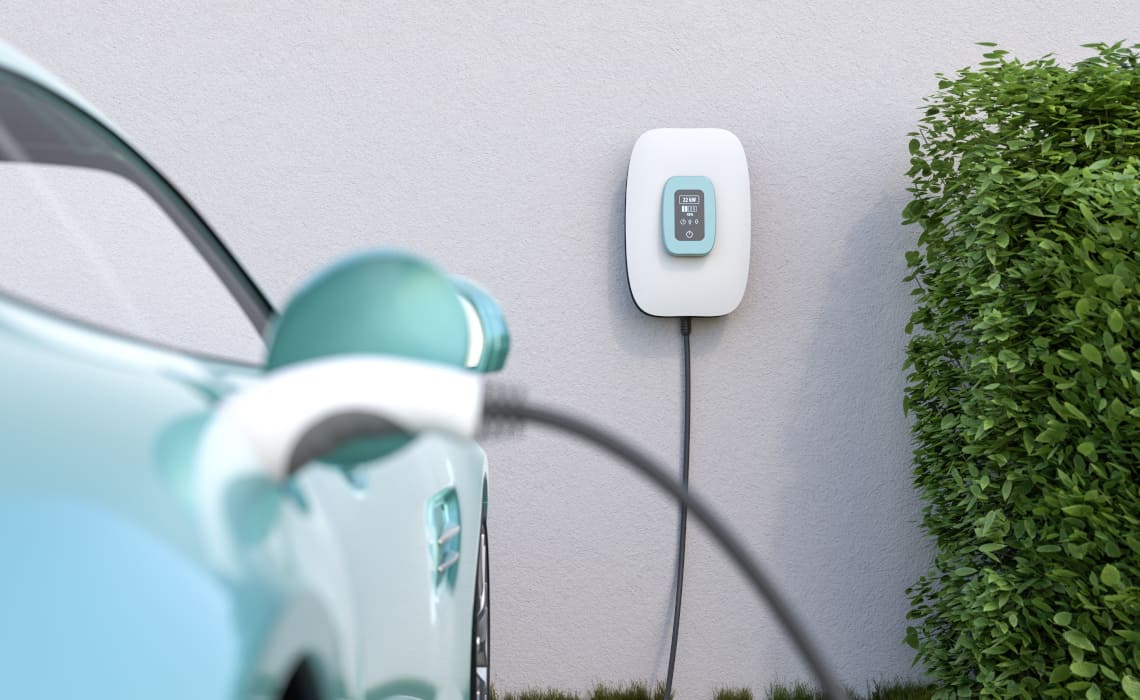
More and more people in Switzerland are driving electric cars, and with each new electric car, the desire to be able to charge at home grows. A private e-charging station, often called a wallbox, ensures that you can charge your electric car safely, quickly and efficiently. It not only improves everyday life, but also increases the value of your property.
To help you understand what to expect financially and technically, here is a comprehensive overview of costs, charging options, subsidies and all the important rules for owners and tenants.
How much does an e-charging station cost?
The most important question first: What costs do you realistically have to reckon with?
The total costs depend primarily on the charging power, the installation and the existing electrical infrastructure.
Material costs for wallboxes
Simple, functional charging stations are available from around CHF 600 to 800. High-quality models with intelligent controls, app connection, PV surplus charging or integrated RCD protection usually cost between CHF 1,000 and 2,000. Powerful premium wallboxes can cost up to CHF 3,000.
Installation costs
The installation often accounts for the largest share of the costs. Typical price ranges:
💡 Practical value:
A wallbox including installation costs CHF 1,500 to 3,000 in most households.
Complex installations (e.g. long cable runs, lack of reserve on the fuse box) can reach up to CHF 4,500.
Get an e-charging station quote
Free & without obligation
With just a few clicks, receive up to 3 wallbox quotes from certified specialists in your area.
Why not charge the electric car via the household socket?
In theory, you can charge your electric car at a normal socket. In practice, however, it is the riskiest option.
With several hours of full load, cables, sockets and transitions quickly overheat, which significantly increases the risk of a cable fire. Older installations in particular are not designed for continuous high currents. In addition, charging takes extremely long: For a 24 kWh battery, you need around 10 hours – and longer for larger batteries.
A wallbox solves all these problems: It offers monitored charging power, coordinated safety, significantly faster charging and convenient operation. Experts recommend installation by a specialist company for safety reasons alone.
Why is a wallbox safer, faster and more convenient?
A private charging station communicates with your electric car and regulates the charging power so that neither the car nor the house installation is overloaded. Compared to a socket, you not only charge faster, but also reduce risks such as overheating, power interruptions or damaged cables. In addition, the charging cable is always within easy reach, which makes everyday life much easier.
The combination with a photovoltaic system is particularly practical: A smart wallbox can automatically charge when your roof is producing solar power – it doesn’t get any cheaper than that.
Charging power, charging plug & intelligent functions
The power of a wallbox ranges from 3.7 kW to 22 kW. The charging speed that is possible always depends on the weakest component in the system: car, wallbox or cable.
A vehicle with a 3.7 kW on-board charger will therefore never charge faster than 3.7 kW, regardless of the wallbox.
In Switzerland and Europe, the type 2 connector is standard. It is three-phase, robust and compatible with all modern electric cars. Only older US or Asian models still use type 1.
Modern wallboxes offer additional functions such as load management, PV surplus charging, user management via RFID, intelligent charging planning or app connection. These extras make everyday life much easier, especially for households with several electric cars or a solar system.
How does a wallbox work technically?
As soon as you plug in the charging cable, the car and charging station exchange information – for example, about the maximum permissible current. The wallbox then only releases as much power as the car can safely absorb.
During the charging process, the power is initially kept high and automatically reduced towards the end to protect the battery. Once the battery is full, the power flow stops completely.
This controlled, monitored communication makes the charging process safer and more battery-friendly in the long term than any socket.
Funding for private e-charging stations
Switzerland supports electromobility at various levels. Many cantons and municipalities offer financial grants – either for the wallbox, the installation or both. You can reliably find out how much your municipality is promoting on the website of energiefranken.ch – category Mobility – charging infrastructure.
Conclusion: Is an e-charging station worth it for me?
A private wallbox is now the most comfortable, safest and most efficient way to charge an electric car. It saves time, protects the electrical installation, enables faster charging times and significantly reduces energy costs – especially in combination with a solar system.
Anyone who thinks long-term, wants a modern property or is planning several electric cars should opt for a professional installation. With the right system and a competent installer, you will benefit from a sustainable, future-proof charging infrastructure for many years to come.
Get wallbox offers
Free & without obligation
With just a few clicks, receive up to 3 offers for your e-charging station from certified specialists in your area.