


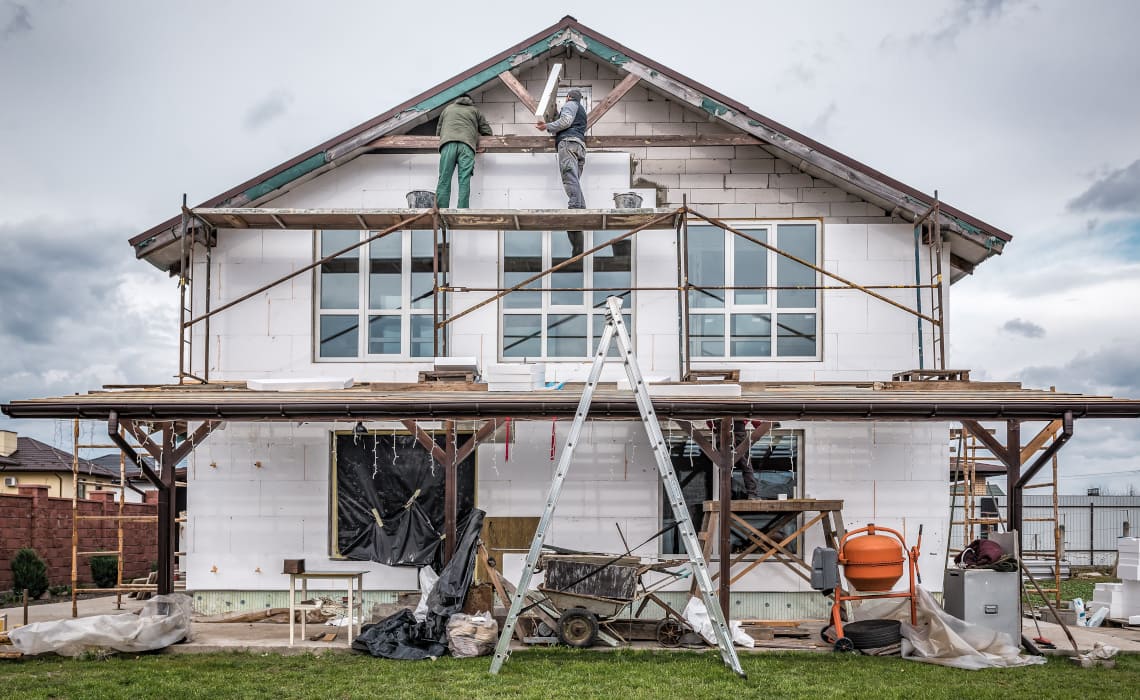
Insulating a facade: Costs, insulation options and important rules
An insulated facade is one of the most effective measures to reduce a house’s energy consumption. A quarter to a third of the heating energy often escapes through uninsulated or poorly insulated exterior walls. This is an unnecessary loss that is directly noticeable in your wallet. A professional facade renovation improves the heat balance, but also increases living comfort and increases the value of the property in the long term.
To help you know what to expect financially and which insulation method makes sense for your building, here is a comprehensive overview.
How much does it cost to insulate a facade?
The costs depend primarily on the insulation technology, the condition of the exterior wall and the facade area. Here you will find the most important guide prices at a glance.
Typical costs per insulation option
The costs for facade insulation vary greatly depending on the type of insulation. The material, insulation thickness, condition of the existing facade, the effort involved in scaffolding and the desired surface design are decisive. To help you realistically assess the price range, here is a comparison of the most important options – clearly explained.
Interior insulation – The special solution for listed buildings
Interior insulation is only used if the facade cannot be changed for aesthetic or legal reasons. It insulates less efficiently than exterior insulation and cannot completely eliminate thermal bridges.
● Costs per m²: CHF 100 – 250
● Total costs for a single-family home: approx. CHF 15,000 – 30,000
Why such big differences? Depending on the material (hemp, wood fiber, calcium silicate, aerogel), both the price and the insulation effect vary greatly. High-performance materials such as aerogel are significantly more expensive, but allow for very thin structures.
Core insulation (cavity wall insulation) – The cheapest option
Core insulation is only suitable for houses with double-shell masonry. The insulation material is blown into the space between the two shells without the need for major structural work.
● Costs per m²: CHF 90 – 130
● Total costs for a single-family home: approx. CHF 15,000 – 20,000
Why is it so cheap? Because no new facade cladding, no plaster structure and less working time are required. However, a suitable cavity is a prerequisite – many modern houses do not have this.
Exterior insulation – External Thermal Insulation Composite System (ETICS)
The ETICS is the most frequently used solution. Insulation boards are mounted on the existing facade and then plastered.
● Costs per m²: CHF 200 – 300
● Total costs for a single-family home: approx. CHF 20,000 – 35,000
Why is the ETICS so popular? It is inexpensive, works for almost all houses and reduces energy loss very effectively. However, the subsequent facade design is less flexible than with a curtain facade.
Exterior insulation – Curtain facade
The curtain facade (also known as a rear-ventilated facade) is considered the highest quality, most durable and architecturally most flexible insulation option. A new outer shell is mounted on a substructure – often wood, metal or fiber cement.
● Costs per m²: CHF 300 – 350
● Total costs for a single-family home: approx. CHF 30,000 – 40,000
Where do the higher costs come from? The construction is more complex: substructure, rear ventilation level, insulation and high-quality exterior cladding increase the material and labor costs. In return, this solution offers the longest service life and enormous design freedom.
Scaffolding costs – Often underestimated
Almost every facade renovation requires scaffolding. The higher the house and the more difficult the accessibility, the more expensive it becomes.
● Costs per m² of facade area: CHF 15 – 25
● Typical total costs: CHF 2,000 – 5,000
Why so different? Narrow access roads, embankments, extensions or winding facades increase the effort required for assembly.
Practical value – What does it cost to insulate a typical single-family home?
For most single-family homes, realistic total costs are between CHF 20,000 and 40,000, depending on: insulation materials and their thickness, type of insulation (interior, core, ETICS, curtain facade), condition of the existing facade, scaffolding costs and desired surface quality. High-quality insulation saves 10–20% heating energy in the long term and pays for itself – together with subsidies – often after just a few years.
Which factors really influence the insulation costs?
The price differences between houses of similar size can be considerable. This is due to several points that strongly influence the effort involved.
The most important factor is the structure of the existing exterior wall. Houses with double-shell masonry can be improved relatively cheaply by core insulation, while solid walls must be insulated from the outside. The building fabric also plays a role: cracks, moisture or damaged plaster layers must be renovated before the insulation is applied. In addition, there is the accessibility of the facade – steep terrain, narrow passages or complex roof shapes increase the scaffolding and labor costs.
The choice of material, insulation thickness and system structure also have a major impact on the final price. High-quality insulation materials such as wood fiber or mineral foam are more expensive, but offer better structural properties. Regional differences in the hourly rates of craftsmen should also not be underestimated. Ultimately, every facade is unique – and that is why the costs also differ. Comparing several quotes is always worthwhile.

Get facade quotes
Free & without obligation
With just a few clicks, receive up to 3 facade quotes from certified specialists in your area.
Which insulation option is right for your house?
Interior insulation: Special solution for listed facades
Interior insulation is only an option if the facade cannot be changed on the outside – for example, in the case of historical facades or half-timbered houses. It is attached directly to the interior wall and consists of wood fiber, hemp, calcium silicate, mineral wool or high-tech insulation materials such as aerogel.
Although it brings energetic improvements, it is structurally demanding, as the risk of moisture in the wall structure is higher. It is only recommended to a limited extent for normal residential construction.
Core insulation: The simplest and cheapest solution
Core insulation is suitable for buildings with double-shell masonry. Insulation material such as mineral wool, EPS or PUR is blown into the cavity. The process is quick, relatively inexpensive and causes little dirt. However, the insulation performance depends on the existing cavity and rarely reaches the values of external insulation.
Thermal composite system: Efficient external insulation
The ETICS is the most common method for single-family homes without a cavity. Insulation boards are glued or dowelled onto the existing facade and then plastered. The method offers good insulation and is attractively priced in relation to performance. The design options are more limited than with a curtain facade, but the structure is thinner and lighter.
Curtain facade: High-quality, durable and excellently insulated
With the curtain facade, a substructure is mounted on which an outer facade panel is placed – for example made of wood fiber, Eternit, metal or wood. The insulation material is located in between.
This construction is particularly robust, optimally protects the wall from moisture and offers maximum design freedom. The costs are higher, but the service life is excellent and damage can be easily repaired.
What subsidies are available for facade insulation?
The energetic renovation of the facade is supported throughout Switzerland. Depending on the canton, you will receive 40–80 CHF per insulated square meter, provided that the new U-value is below 0.2 W/m²K.
Additional programs from individual municipalities or energy suppliers can further increase the subsidy amount.
The exact amount can be most easily determined via energiefranken.ch – there you enter your postal code and get a complete overview of all programs.
The measure is also worthwhile from a tax perspective: all costs for insulation, dismantling and ancillary costs are considered value-maintaining and are deductible throughout Switzerland.
Do I need a building permit for facade insulation?
As soon as you insulate the facade or change the material or appearance, a building permit is required in most cantons.
Only a new facade paint in the same color is considered permit-free.
Since the rules are canton-dependent, you should contact the building authority at an early stage – this prevents delays.
Why facade renovation pays off quickly
An insulated facade is one of the most effective measures to permanently reduce energy costs. It significantly reduces heat loss, increases living comfort, protects the building fabric and increases the value of the property. Thanks to subsidies and tax deductibility, the investment is particularly worthwhile today.
Which insulation option is ideal depends on the building – an experienced facade specialist can reliably assess this and plan a suitable solution.
Get facade quotes
Free & without obligation
With just a few clicks, receive up to 3 facade quotes from certified specialists in your area.