


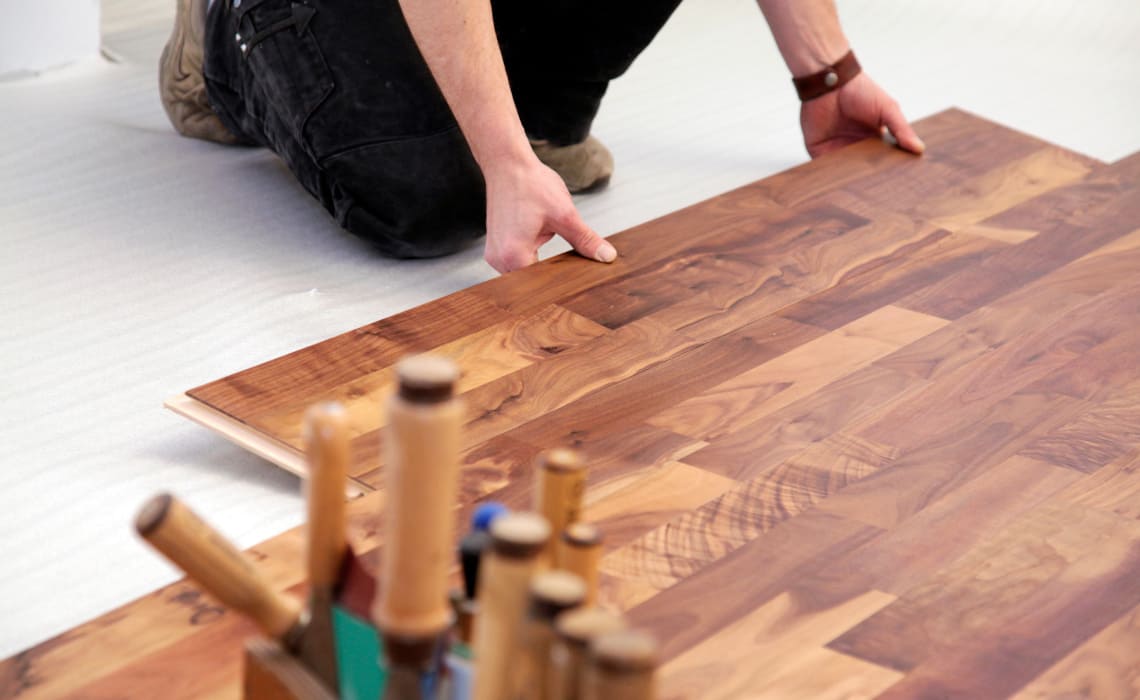
Laying parquet - Costs and selection at a glance
A new floor covering often changes the effect of a room more than new furniture or fresh wall colors. Parquet in particular stands for homeliness, naturalness and value. Whether bedroom, living room or home office: The right floor creates atmosphere and noticeably increases living comfort.
But before a new floor is laid, many questions arise: Which covering suits my everyday life? How high are the costs? And is it worth hiring a professional or can you lay parquet yourself? This guide gives you a well-founded overview of floor coverings, prices, service life and professional installation – with a focus on parquet in Switzerland.
How much does it cost to have a new floor laid?
The costs for a new floor covering depend on several factors: Material, room size, subfloor, type of installation and labor. Although many floor coverings are available in stores, professional installation is crucial for durability and appearance.
If you are very experienced in handicrafts, you can lay certain coverings yourself. However, for parquet, linoleum or complex floor plans, a specialist company is clearly recommended.
The following prices will help you with rough budget planning:
Material
● Inexpensive laminate: CHF 25–60 per m²
● PVC flooring: CHF 40–70 per m²
● Vinyl flooring: CHF 40–70 per m²
● High-quality laminate: CHF 30–60 per m²
● Oak parquet: CHF 40–90 per m²
● Linoleum: CHF 30–60 per m²
● Carpet: CHF 40–80 per m²
● Natural cork: CHF 50–90 per m²
● Cherry parquet: CHF 50–200 per m²
Labor costs
● Hourly rate floor layer: CHF 75 – 95
● Preparation per m²: CHF 15 – 30
● Laying floor per m²: CHF 25 – 50
When is a new floor covering worthwhile?
When is a new floor covering worthwhile?
Floor coverings are durable, but not made to last forever. Depending on the material, stress and care, the service lives differ significantly. At the latest when wear, stains or deformations become visible, a replacement makes sense – often also for optical reasons.
Typical guide values for the service life:
● Cork floor: around 15 years
● Laminate: approx. 15–25 years
● Linoleum: about 20 years
● Parquet: approx. 25–50 years
● PVC / Vinyl: around 20 years
● Carpet: approx. 10–15 years
With good care, parquet in particular can be sanded several times and thus remains attractive for decades.
Get parquet offers
Free & without obligation
With just a few clicks, receive up to 3 parquet offers from certified specialist companies in your area.
Lay it yourself or hire a floor layer?
Not every floor covering places the same demands. While laminate is often laid floating, parquet must in many cases be glued over the entire surface. In addition, subfloor preparation, impact sound insulation, expansion joints and clean finishes are crucial.
Problems quickly arise without specialist knowledge:
● uneven surfaces
● open joints or waves
● poor adhesion
● limited service life
A professional floor layer ensures that the floor is laid technically correctly and lasts for a long time – especially with parquet, underfloor heating or angled floor plans.
Types of parquet at a glance
Parquet is made of real wood and is a living floor covering. Color differences, grains and knot content are natural features and not a quality defect. Depending on the structure, a distinction is made between three types of parquet:
Solid parquet
Consists of one piece of wood and is screwed, nailed or laid floating. Solid wood reacts strongly to moisture and temperature, but can be sanded several times. Hardwoods are more resistant than softwoods.
Finished parquet (multi-layer parquet)
Consists of several layers of wood and is more dimensionally stable than solid wood. The surface is usually already sealed. Finished parquet is often laid with click systems and can also be sanded depending on the wear layer.
Veneer parquet / wooden floor
A cheaper option with a thin real wood layer. Thanks to the low installation height, it is ideal for renovations. The surface is usually UV-sealed and can be used immediately.
Laying the floor correctly – The three methods
Loose laying
The covering is only fixed, e.g. with double-sided tape. Simple, but less stable.
Floating installation
The elements lie loosely on the subfloor and are connected to each other. Movements due to temperature or load are possible. Not ideal for underfloor heating.
Full-surface bonding
The floor is firmly connected to the subfloor. The most durable and stable solution – especially for parquet and underfloor heating.
Get parquet offers
Free & without obligation
With just a few clicks, receive up to 3 parquet offers from certified specialist companies in your area.