


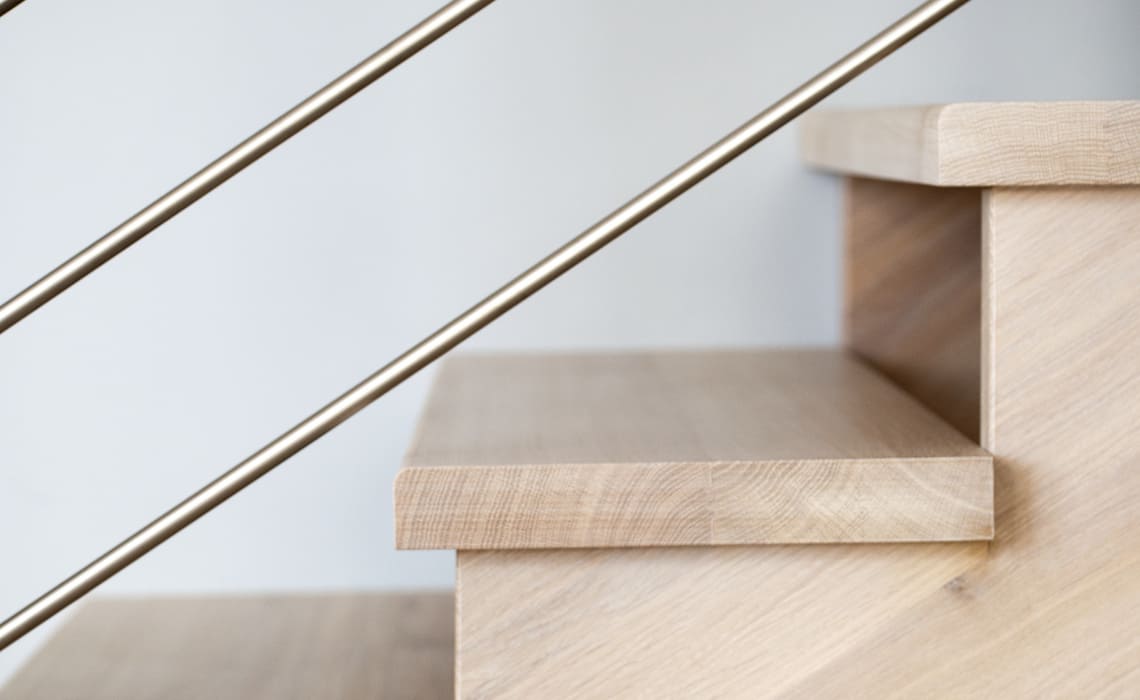
Installing new stairs - Overview of costs & materials
A new staircase changes a room more than almost any other structural element – visually, functionally and in terms of added value. Whether modern, rustic, elegant or minimalist: The choice of the right staircase depends on material, shape, space and budget. At the same time, the costs vary massively depending on the construction (wood, metal, concrete) and the desired railing. In this guide, you will get a clear overview of prices, differences and what you really need to pay attention to when planning & selecting.
How much does a new staircase cost?
A new staircase is one of those investments that has a strong functional and aesthetic impact on the home. However, the costs depend heavily on the material you choose, how complex the construction is, and whether a new railing is also required. To help you plan realistically, here are the typical price ranges per type of staircase – always including installation.
Average total costs per type of staircase (incl. installation)
Concrete staircase – robust & durable
Concrete stairs are ideal for outdoor areas or modern interiors because they are extremely resistant and easy to clean. Due to their high weight and the formwork required, installation is more complex.
Price range: approx. CHF 8,000 – 10,000 (12 steps, incl. labor)
Ideal for: outdoor areas, modern new buildings, heavily frequented zones.
Metal staircase – modern & versatile
Stairs made of aluminum or steel look light, are weatherproof and are suitable for both indoor and outdoor use. Stainless steel is slightly more expensive, but looks particularly high-quality.
Price range: approx. CHF 10,000 – 20,000 (12 steps, incl. labor)
Ideal for: contemporary architecture, outdoor facilities or minimalist interiors.
Wooden staircase – Warm & cozy
Wooden stairs create a natural living atmosphere and are the classic choice for interiors. Beech and oak are in the middle segment, walnut or cherry are significantly higher.
Price range: approx. CHF 12,000 – 15,000 (beech, 12 steps, incl. labor)
Ideal for: living rooms, old buildings, high-quality interior design.
Special shapes – spiral staircase & spiral staircase
These space-saving variants require more planning and customization, which is why material and installation are more expensive. They are ideal for narrow floor plans or as an architectural statement.
Price range: mostly CHF 15,000 – 18,000, depending on material, diameter & railing
Ideal for: small rooms, maisonette apartments, design accents.
Costs for stair railings
A railing not only influences safety, but also the appearance and the overall price. The costs vary significantly depending on the material.
Wooden railing
Warm, classic, perfect for living rooms.
CHF 200 – 500 per linear meter
Metal railing (steel, aluminum, stainless steel)
Durable, modern, large design variety.
CHF 400 – 800 per linear meter (stainless steel is at the upper end)
Perforated sheet metal railing
Robust, modern, popular in outdoor areas.
CHF 400 – 600 per linear meter
Glass railing (glass filling or all-glass)
Very high quality, maximum transparency – but expensive.
CHF 600 – 1,000 per linear meter
Additional costs that are often forgotten
Handrail:
Wood – CHF 100 – 300 per meter
Stainless steel – CHF 200 – 350 per meter
Posts:
CHF 100 – 180 per piece
Clamps & fasteners:
CHF 30 – 50 per piece
These additional items can quickly increase the total price by several hundred francs – so they should definitely be taken into account in the quotation planning.
Get a staircase quote
Free & without obligation
With just a few clicks, receive up to 3 staircase quotes from certified specialist companies in your area.
The most important cost factors – What really influences the price?
Choice of material
The biggest price difference is due to the material: concrete and metal are in the middle to higher price range, while wood varies greatly depending on the type of wood – from beech in the middle to noble woods such as walnut at the upper end. Each material also influences maintenance, service life and the appearance of the house.
Staircase shape
A straight staircase is the cheapest because it involves less material and installation effort. Spiral, platform or spiral staircases are more complex, require exact custom-made products and significantly more working time – accordingly, the total costs increase noticeably.
Number of steps
More steps mean more material, more structural analysis and more working time. Especially with wooden and metal stairs, additional steps noticeably increase the price per step. The number of steps has an even greater impact on the price of spiral staircases.
Type of railing
The railing is a major cost driver. Simple rod railings are inexpensive, while all-glass, stainless steel or perforated sheet metal railings can quickly cost several thousand francs. The handrail material, fastenings and special shapes also influence the final price.
Workload
Simple installation under good working conditions is inexpensive. However, if an old staircase has to be dismantled, the substrate prepared or the statics adjusted, the labor costs increase significantly. Heavy concrete parts or large metal structures also require more specialist personnel or machines.
Custom-made vs. standard solutions
Standard stairs are significantly cheaper because they can be pre-produced. Individual custom-made products – for example for old buildings, special floor plans or special design requests – require detailed planning and individual production, which significantly increases costs.
Access / construction site situation
Narrow entrances, narrow stairwells, upper floors without crane access or complicated transport routes increase the effort. The more difficult the access, the more time and special equipment is required – and the higher the total costs.
What types of stairs are there and which one suits your house?
Concrete staircase
A concrete staircase is ideal if you want maximum stability, long service life and a modern, clear look. It can carry high loads, looks solid and can later be flexibly clad (wood, stone, tiles). Especially in new buildings or large conversions, it is often the most economical solution because it is integrated directly into the building shell. In existing buildings, however, the effort is greater because concrete is heavy and supporting structures must be taken into account.
● Advantages: extremely durable, sound-absorbing, versatile design, easy to clean
● Disadvantages: heavy, complex installation, expensive subsequent adjustments
● Suitable for: new buildings, modern houses, outdoor areas, high loads
Metal staircase
Metal stairs are the right choice if you prefer a light, elegant yet stable construction. They look more filigree than concrete and can be architecturally highly individualized – from industrial to elegant. They are particularly popular for renovations because they are relatively light and easy to retrofit. However, metal structures transmit noise more quickly and require professional coating for outdoor use.
● Advantages: slim look, high load-bearing capacity, ideal for modern designs, easy to install in existing buildings
● Disadvantages: more sensitive to impact sound, susceptible to corrosion outdoors without coating
● Suitable for: modern interiors, lofts, outdoor areas, renovations
Wooden staircase
Wooden stairs bring warmth, comfort and naturalness into the room. They can be perfectly adapted to the interior style in terms of color and offer a very pleasant walking comfort. They are particularly popular in living rooms – from Scandinavian light to classic dark. However, wood reacts more strongly to moisture and requires regular maintenance, especially with intensive use.
● Advantages: warm look, pleasant walking feeling, large design variety
● Disadvantages: more maintenance-intensive, sensitive to moisture and wear
● Suitable for: interiors, family homes, renovations, stylish living concepts
Spiral staircase & spiral staircase
These staircase shapes are ideal if there is little space available or you want to set an architectural highlight. Spiral staircases look more playful and often offer a little more walking comfort, while spiral staircases are extremely space-saving and can be easily integrated into small rooms. However, they are less suitable for large furniture passages or regular use by children or older people.
● Advantages: space-saving, visually very attractive, versatile in design
● Disadvantages: narrow walkway, difficult furniture transport, less comfortable
● Suitable for: small rooms, galleries, attics, stylish accents
Common mistakes when buying stairs and how to avoid them
Wrong material for location
Many choose the material purely based on appearance – without checking whether it is suitable for indoor or outdoor use. Wood looks warm, but is only conditionally weatherproof outdoors and requires a lot of maintenance, while metal or concrete are much more robust. Therefore, decide according to the place of use, climate and desired maintenance effort – not just according to style.
Underestimated installation costs
Many only compare material prices and forget that the installation often costs CHF 2,000–3,000 or more – especially in difficult-to-access installation situations. The removal of an old staircase can also cause additional costs. Therefore, always get a complete quote including dismantling, transport, installation and adjustment work.
Cheap railing solutions
Cheap railings look tempting at first glance, but are often wobbly, poorly made or not durable. Especially with stairs that are used daily, this can quickly become a safety risk. Invest in stable materials (metal, wood, glass) and check the workmanship and the fastening points.
Lack of fall protection
Too low railings, too wide gaps or missing handrails are typical mistakes that can be dangerous in everyday life – especially with children or older people in the household. Modern building regulations specify minimum heights and distances that must be observed. Pay attention to standard-compliant solutions and have the railing professionally installed.
Poor planning of the slope / tread
If steps are too steep, too high or too narrow, the staircase quickly becomes uncomfortable or even dangerous. An optimal slope (17–19 cm) and sufficient tread (min. 26 cm) ensure comfort and safety. Early planning with a staircase builder prevents later functional problems or costly adjustments.
Which staircase really suits your home
A new staircase is more than a necessary structural element – it shapes the character, safety and living comfort of your house. Whether concrete, metal, wood or a space-saving spiral staircase: The decisive factors are your budget, the available space and the desired style. If you think about railings, material quality, slope and installation effort early on, you will save high additional costs later and avoid planning errors. Have specialist companies show you different variants – this is how you will find the solution that works in the long term and is visually convincing.
Get a staircase quote
Free & without obligation
With just a few clicks, receive up to 3 staircase quotes from certified specialist companies in your area.