


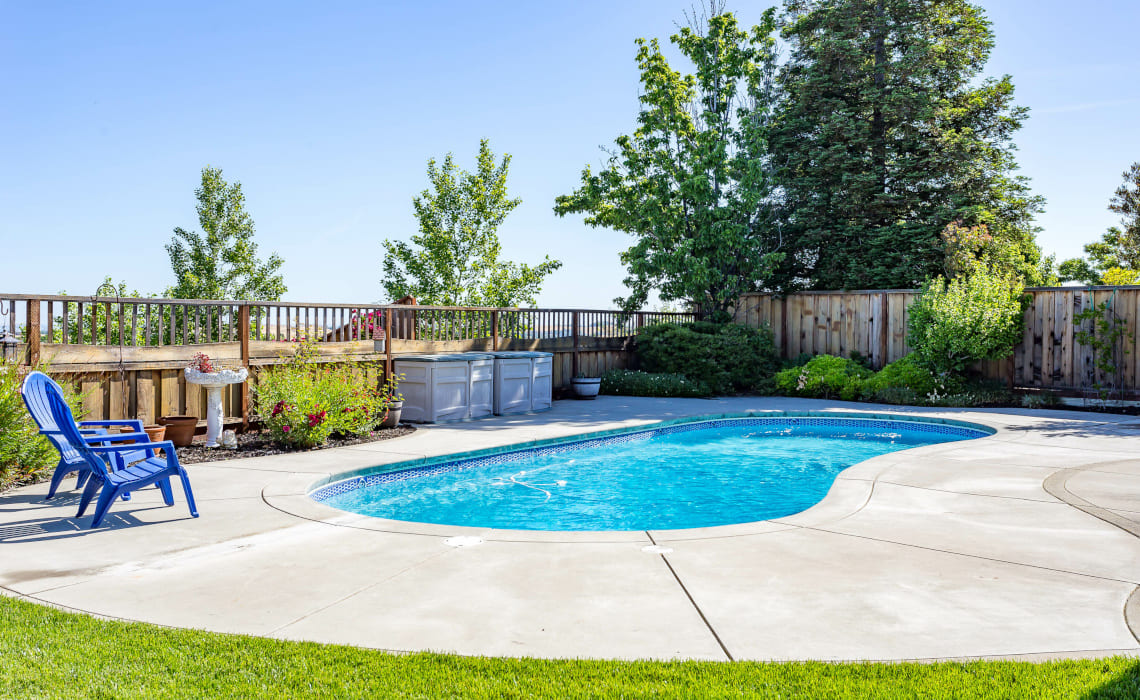
Build a pool: Costs, planning & important tips for your own swimming pool
- 1. What types of pools are there?
- 2. Pool building costs: How much does a swimming pool cost?
- 3. In-ground pool: The high-quality solution for lasting bathing fun
- 4. Above-ground pool: Affordable alternative without major excavation
- 5. The right pool size: How big should a swimming pool really be?
- 6. The ideal location for your pool
- 7. Technology & accessories: This equipment is needed for every pool
- 8. Do you need a building permit to build a pool?
Having your own pool in the garden is a long-cherished dream for many – and in view of increasingly hot summers, it is becoming an increasingly attractive investment. Instead of crowded swimming pools or spontaneous trips to the lake, you have the opportunity to cool off right on your doorstep at any time. A swimming pool also increases living comfort and is a real eye-catcher in any garden.
Before you start building, however, you should know the most important types of pools – and of course the costs that you can realistically expect when building a pool in Switzerland. This guide summarizes everything you need to know.
What types of pools are there?
Basically, there are four types of pools:
● In-ground pool – permanently embedded in the ground, high-quality and durable
● Above-ground pool / steel wall pool – cheaper alternative that stands on a level surface
● Popup pool – flexible film solution, quick to set up
● Paddling pool – for children, the least effort
In this article, we will focus on the two most relevant variants for permanent solutions in the garden: in-ground pools and above-ground pools.
Pool building costs: How much does a swimming pool cost?
The costs depend primarily on the design, size, excavation and technical equipment. To give you a quick overview, here are the most important price ranges at a glance.
Price overview for typical private pools
Labor & installation costs
Realistic total costs for pool construction
● Plastic pool: from CHF 45,000
● Concrete or stainless steel pool: from CHF 55,000
● Annual maintenance costs: approx. CHF 800–1,500
These guidelines will help you make an initial rough cost estimate. The actual costs depend on the terrain, accessibility, pipes and your desired equipment.
In-ground pool: The high-quality solution for lasting bathing fun
An in-ground pool is permanently embedded in the ground and offers the greatest design freedom. The construction work begins with the excavation, the installation of a concrete slab and the backfilling of the pool. There are different designs:
Stainless steel pool
● extremely durable and elegant
● seamless, hygienic and easy to clean
● reduces algae formation due to smooth surface
Plastic pool (GRP, FPO, PE)
● delivered as a finished pool
● is placed in the excavation pit and backfilled with lean concrete
● very good value for money
Element pool
● is assembled from elements
● then concreting & technical installation
● then lined with pool film
Concrete or exposed concrete pool
● maximum design freedom
● suitable for natural stone, porcelain stoneware or glass mosaic
● very robust and durable
In-ground pools are ideal if you want a permanent premium solution that blends harmoniously into the surroundings.
Receive pool system offer
Free & without obligation
With just a few clicks, receive up to 3 pool system offers from certified specialist companies in your area.
Above-ground pool: Affordable alternative without major excavation
Above-ground pools usually consist of a double-walled steel construction with film and are simply placed on the prepared garden floor.
Most models:
● come as complete sets (pool, filter, ladder, care products)
● stay up all year round
● can be clad (wood, plastic, masonry)
They are significantly cheaper than in-ground pools and are ideal if you are looking for a quick, stable and visually appealing solution.
The right pool size: How big should a swimming pool really be?
The right pool size is one of the most important decisions when building a pool. It not only affects the price, but also how comfortable you can swim or relax in it later. Basically, the clearer you know how you want to use the pool, the easier it is to choose.
If you want to swim regularly
Then you should plan for a minimum length of 6 meters. This allows short strokes without constant turning. If you value real swim training, it is better to choose 8 meters or more.
If two people are to swim next to each other
In this case, you need at least 4 meters of width, ideally even a little more. This avoids constantly getting in each other’s way.
Typical sizes for private garden pools
Many single-family homeowners opt for an 8 × 4 meter pool because this format offers a lot of freedom of movement without taking up a disproportionate amount of garden space.
Round pools
If you prefer a round pool, a diameter of approx. 7 meters has proven to be effective – enough to bathe or play comfortably.
Pool depth
The recommended depth is 1.40 meters.
This allows you to stand comfortably without the floor becoming too shallow. 80 cm of water depth is sufficient for swimming, but many households opt for 1.40–1.50 meters for comfort reasons.
💡 Important to know:
A smaller pool is not automatically much cheaper.
Technology, filter system, connections and excavation cause fixed costs that can hardly be reduced. A small pool may require less water, but the savings are less than many expect.
The ideal location for your pool
A good location is crucial to how much you enjoy the pool later – and how high the running costs are. Sun, wind, shade and proximity to buildings directly affect water quality, energy consumption and effort.
Sunny location
The pool should get as many hours of sunshine as possible – ideally facing southeast.
Why? The sun warms the pool in the morning, which is not only pleasant, but also saves heating costs.
Distance to trees
Make sure not to plan the pool directly under or next to large trees.
Leaves, flowers and needles quickly end up in the water and make unnecessary work for you. Trees also cast shade – the water cools down faster.
Proximity to water and electricity connections
The closer the pool is to existing pipes, the cheaper the connection will be.
Long pipe routes increase the workload and thus the overall costs.
Wind and privacy protection
Hedges, walls, garden fences or architectural elements help to make the pool area more pleasant:
● less heat loss due to wind
● more privacy
● pleasant quality of stay around the pool
Note accessibility
A pool is often maintained, cleaned and serviced for years – therefore choose a location that is easily accessible, offers enough space for technology and maintenance and is not too close to sensitive building parts.
Technology & accessories: This equipment is needed for every pool
A beautiful pool is only as good as its technology. It ensures that the water remains clean, hygienic and pleasantly warm. Those who save on accessories often pay later with extra effort or higher operating costs.
Filter system / circulation pump
The filter system is the center of every pool technology. It keeps the water in motion and filters out dirt particles. Modern pumps often work with variable speeds, which is more efficient and quieter.
Pool cover
Essential for protection and hygiene:
● reduces pollution
● prevents heat loss
● reduces evaporation
● ensures greater safety (especially electric roller covers)
Ladder or stairs
Access solutions improve safety and comfort – especially important for children or older people.
Pool lighting
Not only visually beautiful, but also practical if you bathe in the evening or want to enhance the atmosphere in the garden.
Pool robot
An automatic pool robot takes a lot of work off your hands. It cleans the floor, walls and sometimes even the waterline. This keeps the pool clean for much longer – and you save time.
Water quality & care: This is how your pool stays clean
In order to prevent algae growth or cloudy water from forming in the pool, several factors must be correct: cleaning, chemical treatment and regular monitoring of the values.
Filtering & circulation
The water should be circulated for several hours every day. This keeps it hygienic and clear.
Chemical or physical water treatment
The most common methods include:
● Chlorine (classic, very effective)
● Active oxygen (gentle, suitable for sensitive people)
● Sand or glass bead filter
● Chlorozone / salt electrolysis (more natural, less chlorine smell)
pH control
The pH value should be between 7.0 and 7.4, otherwise:
● eyes can be irritated
● acids attack metals and joints
● cleaning agents work worse
Many pool owners use automatic pH regulators that keep the water quality stable.
Automated cleaning
Pool robots or automatic dosing systems take over many tasks automatically. This investment is particularly worthwhile for larger pools because it saves a lot of time and effort.
Do you need a building permit to build a pool?
For most pool projects, the answer is: Yes, a building permit is required.
The Spatial Planning Act stipulates that structural systems – which include almost every permanently installed pool – must be approved. The most important exception concerns popup pools or small, temporary above-ground pools that are only up in the summer and are not permanently installed.
Since the permit requirement varies depending on the canton, municipality and pool type, you should definitely clarify the following points before construction begins:
● Does the project have to be submitted?
● Are there distance regulations to the neighboring property?
● Are safety measures required?
● Is a noise protection test required (e.g. for filter systems)?
A quick call to the building authority of your municipality will give you clear security – and prevent unpleasant surprises.
Conclusion: Is a pool worth it?
A pool is a major investment, but it can be worth it – both financially and for your quality of life. With professional planning and a realistic cost overview, you can implement your project step by step.
Receive pool system offers
Free & without obligation
With just a few clicks, receive up to 3 pool system offers from certified specialist companies in your area.