


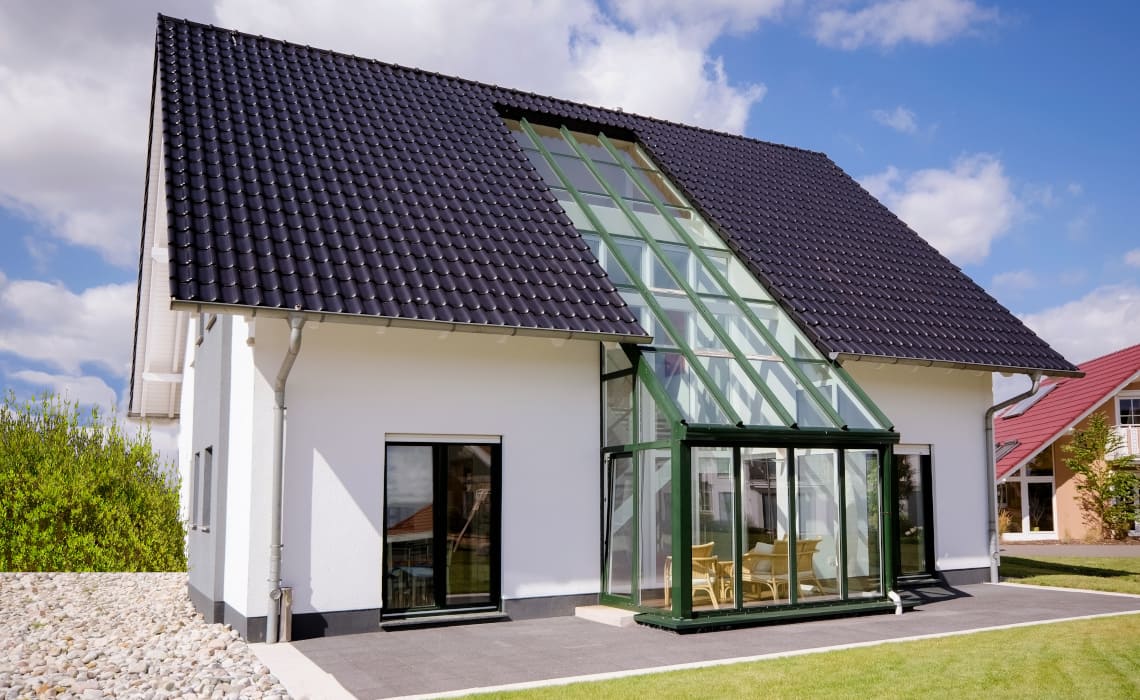
Building a conservatory - Costs and planning at a glance
- 1. How much does a conservatory cost?
- 2. Total costs by conservatory type
- 3. Individual costs at a glance
- 4. Cost factors that many underestimate
- 5. Types of conservatories
- 6. Location & orientation of the conservatory
- 7. The right materials for your conservatory
- 8. Building permit
- 9. Common mistakes when building a conservatory
- 10. Conservatory - One of the most valuable extensions
A conservatory is one of the most attractive ways to expand living space while gaining more light, contact with nature and quality of life. Whether as a cozy retreat, additional dining area, plant oasis or modern living space extension – a well-planned conservatory can significantly increase the value of your property.
But before you start with the implementation, you should know which type of conservatory suits your needs, what costs are realistic and what requirements apply to material, glazing, statics and building permits.
In this guide, you will receive a clear, independent overview of costs, differences between unheated, partially insulated and heated conservatories, typical sources of error – and what you really need to pay attention to in the planning so that your conservatory works in the long term.
How much does a conservatory cost?
The costs for a conservatory vary greatly – depending on the construction, energy requirements, choice of materials and installation effort. Therefore, it is important for owners to first determine the type of conservatory. The differences between unheated, partially insulated and heated conservatories are enormous – not only in terms of price, but also in terms of possible uses and operating costs.
Typical total costs by conservatory type
Unheated conservatory (summer garden) – without foundation – approx. 32 m²
Price range: from approx. CHF 35,000–60,000
A cost-effective solution, ideal as a weather-protected outdoor space in spring/autumn. Not heated, no insulation regulations, lightweight constructions.
Partially insulated conservatory – with foundation – approx. 32 m²
Price range: CHF 40,000–65,000
Can be used to a limited extent all year round, slight heating possible. Better glazing and profiles, higher installation effort – but cheaper than fully-fledged living space.
Heated conservatory (heated living space) – with foundation – approx. 32 m²
Price range: CHF 50,000–75,000
Is considered a living space extension under building law. Triple glazing, fully insulated profiles, foundation, heating, electrics. Highest costs, but maximum comfort.
The more you want to use the conservatory like a living space, the closer the project gets in price to a classic extension.
Individual costs at a glance
● Simple conservatory, 15 m², without extras: 15,000 CHF
● Heating for 15 m² conservatory: 3000 CHF
● Ventilation systems: 1,500–3,000 CHF
● Foundation, if necessary for 15 m²: 3,000 – 5,000 CHF
These positions together result in the final price. Therefore, large differences between offers are completely normal.
Cost factors that many underestimate
Statics & snow load
Heavy triple glazing and snow load zones increase material dimensions and installation effort.
Heating costs & operation
Heated conservatories can cause high operating costs in winter if insulation and shading are poorly planned.
Shading
Without external sun protection, a conservatory gets extremely hot in summer – many forget these additional costs.
Electrical controls
Automatic shading, ventilation & sensors increase comfort, but also the budget.
Accessibility & construction site
Difficult installation locations (terraces, raised extensions) require additional equipment.
Winter suitability
If you want to live in the winter room, you absolutely need high-quality glass and profile technology – the main cost driver.
Get a conservatory quote
Free & without obligation
With just a few clicks, receive up to 3 conservatory offers from certified specialist companies in your area.
Three types of conservatories – But which one suits your house?
A conservatory is not just a conservatory. The decisive factor is how and when you want to use the room – only in summer, in the transitional period or all year round. The three types of construction differ massively in costs, insulation values, requirements and comfort. This section clearly shows you which solution really suits your building, your budget and your expectations.
Unheated conservatory (summer garden)
An unheated conservatory consists of light, non-insulated profiles and large glass surfaces. It is primarily suitable for spring to autumn – for eating, relaxing or overwintering plants. It is hardly heatable, because the thermally non-separated profiles do not store heat.
● Advantages: cheapest variant, maximum transparency, quick installation.
● Disadvantages: often too cold in winter, not a fully-fledged living space.
● Suitable for? For everyone who wants as much glass surface and summer use as possible – with a moderate budget.
Partially insulated conservatory
The partially insulated conservatory is the most popular intermediate solution: better profiles, slight thermal protection, but no fully-fledged living space insulation. You can use it well in transitional periods, and it warms up quickly on sunny winter days.
● Advantages: good balance of costs, comfort and flexibility, can be opened over a large area.
● Disadvantages: not warm enough in the deep winter without sun; not a fully-fledged living space according to energy law.
● Suitable for? For households that want to use spring–autumn and do not necessarily want to heat in winter.
Heated conservatory / residential conservatory
The heated conservatory is a real living space, heated and usable all year round. It requires fully insulated profiles, high-quality triple glazing and a correctly constructed foundation. This makes it the most expensive, but most comfortable solution.
● Advantages: year-round living space (home office, dining room, lounge), highest insulation values, increase in property value.
● Disadvantages: highest construction costs, strict building and energy regulations, professional planning mandatory.
● Suitable for? For everyone who wants more living space permanently and is willing to invest in energy efficiency and high-quality construction.
Location and orientation of the conservatory – The most important factor for comfort & energy
The location of a conservatory has a greater impact on comfort, energy use and later heating or cooling costs than any material or glazing. Especially in the Swiss climate, sun, shade and heat have very different effects – and those who plan cleverly here save high operating costs later.
In winter, optimal sunlight is crucial: A south-facing conservatory captures the low-lying sun and heats the room passively, often even without additional heating. East-facing conservatories benefit from pleasant morning sun, while west-facing locations provide a lot of heat in the afternoon and evening.
In summer, however, a south or west orientation can lead to overheating if there is no external sun protection or sufficient ventilation.
Equally important are storage masses in the floor or in walls – such as natural stone, ceramics or concrete. They store the free solar heat and release it slowly later, which stabilizes the room temperature and improves the energy balance. At the same time, a conservatory influences the temperatures of the adjacent living spaces: Correctly placed, it can serve as a thermal buffer and make the entire house more efficient.
The right materials for your conservatory
The material decision influences price, lifespan, energy efficiency and the overall appearance of your conservatory. Each construction has specific strengths – the decisive factor is how large your conservatory should be, whether it is heated and how much maintenance you want to invest.
Aluminum – stable, elegant & almost maintenance-free
Aluminum is the most popular material for modern conservatories because it is extremely dimensionally stable, durable and suitable for large glass surfaces. The profiles are slim, carry high loads and require little maintenance. Thermally separated aluminum profiles are mandatory for heated conservatories to avoid thermal bridges. In terms of price, aluminum is in the higher segment, but convinces with its lifespan and low maintenance.
Wood – natural, warm & excellent insulation
Wood has a homely effect, offers the best thermal insulation of all materials and is ideal for heated conservatories or extensions that should feel like a real living space. Laminated timber is usually used in terms of quality, as it is resilient and dimensionally stable. However, wood requires regular maintenance against moisture and UV radiation. Perfect for traditional houses or high-quality extensions.
Wood-aluminum – the premium combination
Cozy wood inside, a weatherproof aluminum shell outside: Wood-aluminum systems offer the best of both worlds. They are extremely durable, easy to maintain and visually high-quality. The price is higher than wood and aluminum, but you save in the long term through minimal maintenance and maximum energy efficiency. Ideal for residential conservatories with sophisticated demands.
Plastic – cheap & easy to maintain, but limited use
Plastic constructions are inexpensive and very easy to maintain, but lose stability with larger spans. Plastic is a cost-effective solution for small, unheated conservatories. However, the material quickly reaches its limits with heated conservatories or large glass surfaces. Well suited for budget projects with manageable sizes.
Steel – extremely resilient, but only conditionally suitable
Steel is very load-bearing and is occasionally used for conservatories – often in combination with wood or aluminum. However, steel is susceptible to corrosion, must be galvanized or coated and offers little insulation. This makes it particularly suitable for summer gardens or greenhouse solutions, less for heated residential conservatories.
Does a conservatory need a building permit?
In Switzerland, a conservatory is considered a structural extension and is therefore always subject to approval, regardless of size or design. Important are the boundary distances, which vary depending on the municipality, as well as any fire protection regulations, especially if the conservatory connects to existing facades.
In the case of condominium ownership, the consent of the owners is also required, as a conservatory changes the appearance of the building. If the conservatory is connected to the heating system, it counts as living space under tax and building law and is subject to stricter regulations.
Common mistakes when building a conservatory and how to avoid them
A conservatory is technically more demanding than many think. The following mistakes are typical – and can be easily avoided with professional planning.
Wrong location
If the sunlight is misjudged, the conservatory overheats in summer or remains uncomfortably cold in winter. A simulation of the sun’s path prevents misplanning.
Unsuitable glazing
Single or outdated insulating glazing leads to huge energy losses. Triple glazing is mandatory for heated conservatories.
Lack of ventilation
Without controlled air exchange, condensation, moisture damage and mold occur. Opening elements on at least two sides are mandatory.
Missing structural planning
Conservatories carry high glass loads and are exposed to wind pressure. Without static calculation, deformations or leaks threaten.
Underestimated shading
Even good glazing does not prevent summer heat. External blinds or awnings are essential.
Cheap, unstable systems
Cheap kits seem tempting, but rarely withstand the Swiss weather in the long term. Professional systems save money in the long term.
Why a conservatory is one of the most valuable extensions
A conservatory combines living comfort, light and nature like hardly any other part of the building. Whether unheated unheated conservatory, partially insulated model or fully-fledged residential conservatory: With the right planning, location choice, glazing and shading, a room is created that noticeably enriches your everyday life. It is crucial to clarify the right questions early on – especially statics, energy behavior, permit requirements and material selection. Those who plan carefully here and work with experienced specialist companies receive a durable, energy-efficient and comfortable conservatory that sustainably increases the value of the property.
Get a conservatory quote
Free & without obligation
With just a few clicks, receive up to 3 conservatory offers from certified specialist companies in your area.